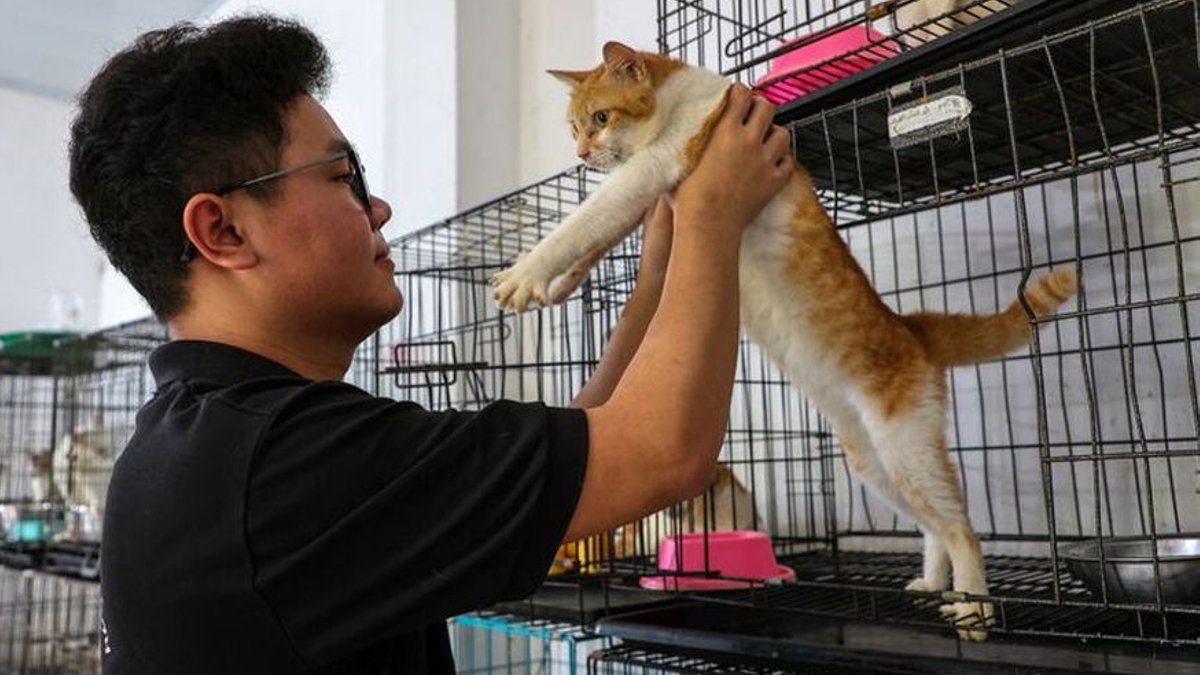
In Hanoi, Kieu Minh Phuong is scouring a roadside market, searching for his 9-year-old calico cat among numerous animal cages containing cats, dogs, rabbits, and fighting roosters, all destined for various fates.
Kieu Minh Phuong searches for his missing nine-year-old calico among many cages holding animals intended for either sale as pets or slaughter for meat.
The 40-year-old ceramics dealer believes his cat Dom was likely stolen, noting she had never disappeared before and neighbors also lost pets that same night.
The cat had never gone missing before, and several neighbours also lost pets the same night.
Pet Theft Rings
Vietnamese police report detaining scores of suspected pet thieves this year, accused of stealing thousands of cats and dogs to sell for slaughter.
This crime is categorized as property theft. Selling, buying, and eating cat and dog meat is legal in Vietnam.
While there is no nationwide database, authorities occasionally publish accounts in police-run newspapers. Last month, Ho Chi Minh City police arrested 12 people accused of stealing 2,700 cats destined for the meat trade. In April, Hanoi police arrested five people over the theft of more than 300 cats.
According to these reports, criminals typically operate late at night, riding motorcycles and carrying sacks, duct tape, and makeshift weapons, including improvised stun guns, to subdue the animals.
Cultural Shift
These criminals operate within the context of a changing culture in Vietnam, a country of 100 million people, where attitudes are largely divided along generational lines.
Read Also: Spain’s Growth Fails to Ease Voter Financial Strain
Younger Vietnamese increasingly see dogs and cats as pets. The Hanoi municipal government has tried to limit the trade in dog and cat meat to match global standards.
Even with these efforts, the meat remains on menus nationwide, and whole roasted dogs are still visible in street stalls in parts of the capital.
The increase in pet ownership has given thieves more potential targets, which can be sold into an existing meat trade.
Prices vary, but according to police reports, a live dog fetches around $1.50 per kg (68 cents per pound), while a cat goes for closer to $5 per kg. For context, Vietnam’s minimum wage ranges from 69 cents to 99 cents per hour.
“Cat meat is a favorite dish for working-class people,” said Tran Thanh, a 50-year-old truck driver from Haiphong.
For about $23, a group of six can share a cat-meat hot pot.
The consumption of dog and cat meat has a long history in Vietnam, with some believing it boosts vitality or wards off bad luck.
While official figures are unavailable, animal welfare group Four Paws International estimated in a 2020 report that over 5 million dogs and 1 million cats were slaughtered annually.
He closed his business in 2019 due to a significant drop in sales.
Read Also: Big Ten’s playoff hopes hinge on one team
In 2018, Hanoi’s government urged residents to stop eating dog and cat meat, stating it harms the city’s image and contributes to the spread of rabies.
Last year, the city launched a pilot program to encourage dog and cat meat traders to transition to other professions by providing vocational training. According to the finance ministry-run Vietnam Investment Review, one year into the initiative, 28 businesses had made the switch.
Open-Air Trade Challenges
By law, vendors must show proof of origin for the animals they sell, but locals report weak enforcement. At a wet market in Hanoi, three out of five stall operators approached by reporters admitted they did not know where their animals came from. All declined to give their names.
Volunteers often intervene, buying the animals for more than their meat value, said Phan Trung Thanh, the non-profit’s communications manager.
However, SNNC has had to reduce rescues due to limited funds, as it already cares for roughly 1,400 animals.
Phuong has not found his cat a month after her disappearance.
He continues to monitor online platforms where people post photos of animals, demanding payment for their return.
“Dom was my emotional support,” he said.