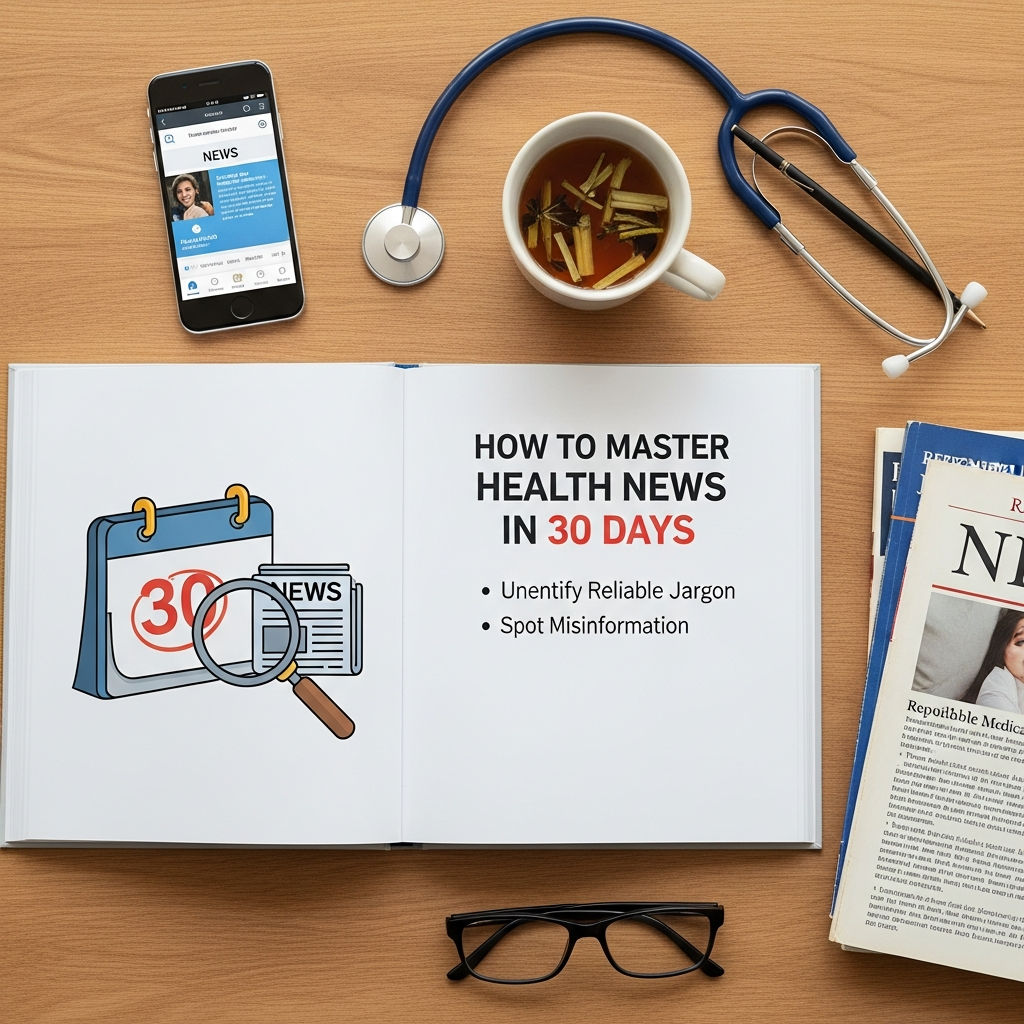
How to Master Health News in 30 Days: A Step-by-Step Guide to Medical Literacy
In an era of viral TikTok health hacks, sensationalist headlines, and conflicting nutritional advice, staying informed about your health can feel like navigating a minefield. One day, coffee is a miracle antioxidant; the next, it’s linked to high blood pressure. How do you separate the breakthrough science from the clickbait? Mastering health news isn’t about becoming a doctor; it’s about developing medical literacy.
If you are tired of feeling overwhelmed by the constant stream of medical updates, this 30-day roadmap will transform you from a passive consumer into a savvy health news expert. By the end of this month, you will be able to dissect a study, spot a biased headline, and understand how new research actually applies to your life.
Week 1: Curating Your Digital Health Diet
The first step to mastering health news is to clean up your “information diet.” If your primary source of health information is a social media algorithm, you are likely missing the full picture. Your first seven days are dedicated to establishing a foundation of reliable sources.
Day 1-3: Identify Gold-Standard Sources
Not all outlets are created equal. To master health news, you must prioritize sources that employ medical experts and subject-matter journalists. Start by bookmarking the following:
- Peer-Reviewed Journals: The New England Journal of Medicine (NEJM), The Lancet, and JAMA (Journal of the American Medical Association).
- Government Agencies: The CDC, NIH, and the FDA provide data-backed public health updates.
- Academic Institutions: Harvard Health Publishing, Mayo Clinic, and Johns Hopkins Health Review.
- Trusted News Desks: STAT News, Kaiser Health News (KHN), and the health sections of the New York Times or Science Magazine.
Day 4-7: Set Up Your News Ecosystem
Instead of hunting for news, let the news come to you in an organized fashion. Use an RSS reader like Feedly or sign up for specialized newsletters. Avoid “wellness” blogs that sell supplements, as their information is often biased toward their products. Focus on newsletters that summarize the week’s top medical abstracts in plain English.
Week 2: Decoding the Language of Science
During the second week, you need to learn the “rules of the game.” Scientists and health journalists use specific terminology that can be misleading if you don’t know the definitions. Understanding these terms is the key to medical literacy.
The Hierarchy of Evidence
To master health news, you must understand that not all studies carry the same weight. When you see a headline, look for the study type:
- Systematic Reviews and Meta-Analyses: These are the “gold standard” because they look at all available research on a topic.
- Randomized Controlled Trials (RCTs): These test an intervention against a control group and are highly reliable.
- Observational Studies: These show correlation but cannot prove causation. Most “dietary” headlines come from these.
- Animal or Cell Studies: These are “pre-clinical.” If a study was done on mice, it does not necessarily mean the same results will happen in humans.
Relative vs. Absolute Risk
This is where many headlines lead readers astray. A headline might scream, “Bacon Increases Cancer Risk by 20%!” This is usually relative risk. If your original risk was 5%, a 20% increase only moves it to 6%. Understanding the absolute risk helps you keep the news in perspective and prevents unnecessary panic.
Week 3: The Art of Fact-Checking and Spotting Bias
Now that you have your sources and your vocabulary, it’s time to put on your detective hat. Week three is about developing a critical eye for every article you read.
Check the Funding and Conflicts of Interest
Always scroll to the bottom of a study or look for a disclosure in a news piece. If a study claiming that “dark chocolate improves memory” was funded by a major candy manufacturer, you should view the results with a healthy dose of skepticism. While industry funding doesn’t always mean the science is bad, it does mean the results are more likely to be framed positively.
The “SMELL” Test for Health News
Use this acronym to evaluate any health claim you encounter:
- S (Source): Who is providing the information? Are they an expert?
- M (Motivation): Is the author trying to sell a book, a supplement, or a subscription?
- E (Evidence): Is the claim backed by a peer-reviewed study, or is it an anecdote?
- L (Logic): Does the claim sound too good to be true? (e.g., “Lose 30 pounds in 3 days”).
- L (Left out): What is missing? Did they mention the side effects or the limitations of the study?
Beware of “Miracle” and “Breakthrough”
Science is an incremental process. True “breakthroughs” are rare. If an article uses hyperbolic language or claims to have found a “cure-all,” it is likely exaggerating the findings of a much smaller, more nuanced study.
Week 4: Application, Synthesis, and Communication
In the final week, you will learn how to turn information into action. Mastering health news is useless if it doesn’t help you lead a healthier life or make better decisions with your physician.
Day 22-25: Connecting the Dots
Don’t look at health news in a vacuum. When you read about a new finding regarding heart health, compare it to what you learned last week. Is the new study confirming the old one, or is it an outlier? Experts look for a consensus of evidence rather than shifting their entire lifestyle based on a single headline.
Day 26-28: Preparing for the Doctor’s Office
The goal of medical literacy is to become a partner in your own healthcare. If you read about a new treatment or a change in screening guidelines that applies to you, print out the abstract or the article. During your next appointment, ask your doctor: “I saw this recent study in JAMA regarding [Topic]. How does this apply to my specific health profile?” This turns “news” into “personalized medicine.”
Day 29-30: Become a Responsible Sharer
The final step of mastery is teaching others. When you see a friend share a misleading health infographic on social media, you now have the tools to gently provide context. By sharing high-quality sources and explaining the difference between correlation and causation, you help improve the health literacy of your entire circle.
Conclusion: The Lifelong Benefit of Health Literacy
Mastering health news in 30 days isn’t about memorizing medical textbooks; it’s about building a filter. In one month, you have moved from a place of confusion to a place of empowered skepticism. You now know that a “clicky” headline is just an invitation to dig deeper, and that “science” is a moving target that requires constant evaluation.
As you move forward, remember that health news is a tool for better living, not a source of anxiety. Keep your sources high-quality, your skepticism sharp, and your focus on the long-term trends rather than the daily noise. You are now equipped to navigate the complex world of modern medicine with confidence.