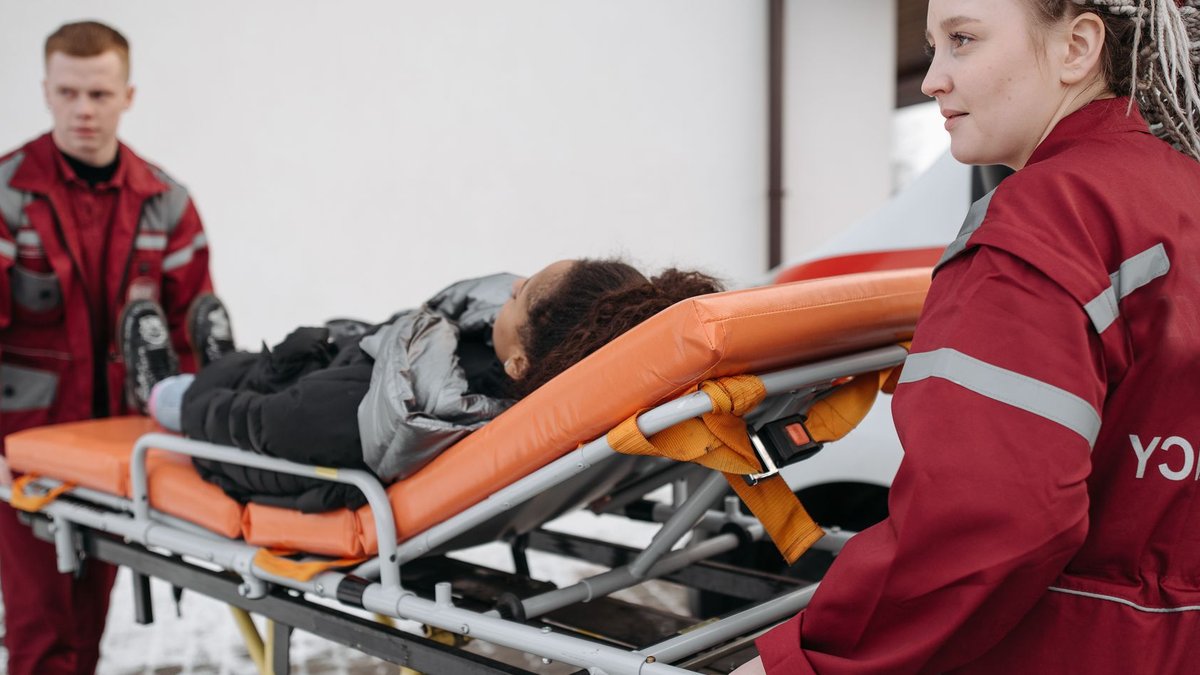
The emergency line at Yobe State Emergency Medical Ambulance Services (YEMABUS) received a call at 6:27 AM on a Saturday morning. A 41-year-old woman named Aisha, calling from a village near Damaturu, reported that her 25-year-old sister-in-law, Fatima, was in active labor. Aisha had previously faced significant challenges accessing medical care during her own pregnancies, delivering all four of her children at home due to the absence of nearby health services and transportation difficulties in her rural area.
When Fatima’s labor became more intense at dawn, Aisha dialed Nigeria’s emergency number, 112, and within one minute, YEMABUS confirmed their location and dispatched a response team. “In my time, getting to a hospital was nearly impossible because we lived in a rural area and we were always on the move with our cattle,” Aisha remembered. “Watching the ambulance pull up right to our door felt like a miracle. They brought Fatima safely to the Yobe State Specialist Hospital in Damaturu within minutes, and she delivered a healthy baby boy shortly after.” Nigeria recorded an estimated 993 maternal deaths per 100,000 live births in 2023, one of the highest maternal mortality ratios globally.
For women experiencing obstetric emergencies, whether care can be reached quickly can determine survival. The Three Delays Model, widely used to understand preventable maternal deaths, identifies three critical points at which care can break down: deciding to seek care, reaching an appropriate health facility, and receiving timely, adequate care after arrival. For several residents, transport was a recurring obstacle to reaching emergency care. When a pregnant woman develops complications that cannot be managed safely at the primary health care (PHC) level, rapid referral to an appropriately equipped secondary or tertiary facility becomes critical. Yet families may still have to contend with transport costs, poor roads and limited transport, particularly at night.
In response to these barriers, the Yobe State Government partnered with the National Emergency Medical Services and Ambulance System (NEMSAS) in May 2023 to establish YEMABUS. The agency provides 24-hour free emergency transport for pregnant women, children under five, accident victims, and patients suffering from snakebites or severe trauma. Dispatchers at the agency’s call centre monitor the national 112 line and local state hotlines. “Once we confirm an emergency, we send the caller’s details, category, and exact location to dispatch and immediately assign a crew,” Idris Muhammed, a YEMABUS call centre officer, explained. “While the vehicle is en route, our team maintains phone contact with both the crew and the patient’s family to provide real-time updates and instructions,” he added.
YEMABUS’s Establishment
A community health worker with YEMABUS’s Potiskum unit, who asked not to be named, said care begins when the crew reaches the patient. With nine ambulances, YEMABUS covers a 30-kilometre radius around major units including Damaturu, Potiskum, and Gashua, while collaborating with PHCs to coordinate localised ambulance transfers in hard-to-reach areas. According to YEMABUS, the ambulances are equipped to support basic pre-hospital stabilisation, including oxygen, suction devices, vital-sign monitors, cervical collars, and emergency obstetric supplies. Under a state-mandated 48-hour free care policy, emergency patients transported by YEMABUS are admitted and stabilised at receiving state facilities without upfront payments for initial drugs or care.
The community health worker narrated that weeks ago, at around 1:00 a.m., 27-year-old Zainab Musa experienced heavy antepartum haemorrhage during labour. Her family called the hotline, and the crew stationed in the town arrived there within minutes. “When we reached the patient, we alerted the receiving emergency team at Specialist Hospital Potiskum so they were prepared to receive the patient the moment we arrived,” he noted. YEMABUS tracks response times for critical emergencies, aiming to reach any location within 15 minutes in Damaturu. Musa, an ambulance driver, added that crews keep fuel tanks full and address routine maintenance immediately so mechanical issues don’t delay responses.
In 2025 alone, YEMABUS responded to over 7,000 emergency dispatches. However, operational challenges remain. Drivers interviewed for this article said traffic congestion and road users failing to yield to sirens can delay responses in Damaturu and Potiskum. This points to a need for community sensitisation to help road users understand the urgency of ambulance journeys and the importance of giving way.
Zanna Ali Haruna, an ambulance crew team lead in Damaturu, explained that dispatchers and drivers regularly contend with telecom network drops, mid-call phone battery failures among distressed callers, crowded incident scenes, and prank calls that waste fuel. “We have had instances where two vehicles were dispatched to a reported severe crash or obstetric emergency, only to arrive and find nothing. There was a time when a family called us, but within five minutes, they put the labouring woman in a commercial tricycle out of anxiety, and left for the hospital in a commercial tricycle before the ambulance arrived,” Zanna shared.
Expanding Access and Awareness
Crew members emphasize that YEMABUS serves all residents regardless of financial status. “Whether a patient is wealthy or has no money at all, arriving in a YEMABUS ambulance guarantees that receiving hospital teams attend to them immediately with equal priority,” he said. For women facing obstetric emergencies, however, an ambulance is only one part of the pathway to survival. Its value depends on how quickly a call is responded to, whether trained teams can stabilise patients en route, and whether receiving facilities are ready with the staff, blood supply, medicines, and equipment required to provide definitive care. Public outreach programs and radio broadcasts continue to clarify that the service is available to everyone without income restrictions.