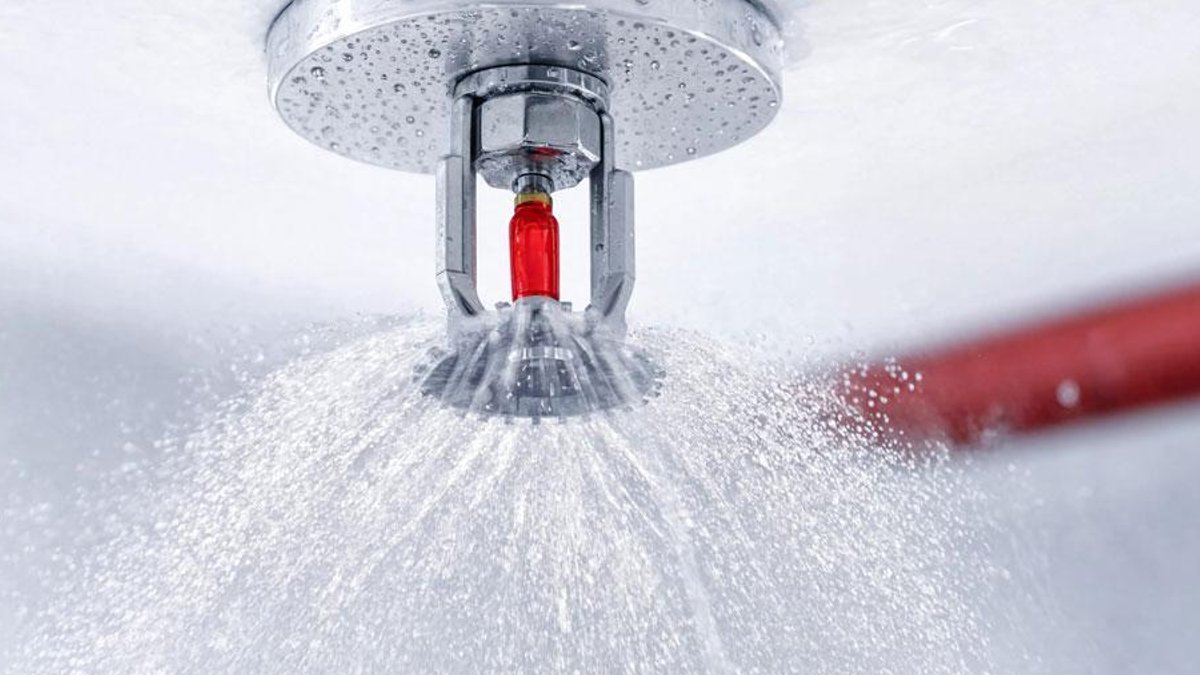
Building owners and facility managers should ensure their fire sprinkler systems remain legally fit for purpose. Paul Markham, of the Fire Protection Association, explains why compliant servicing and certification are essential to guaranteeing these systems operate effectively when they are needed. Sprinkler systems are an integral part of the building fabric and can stand idle for long periods, yet they are required to operate in earnest to allow evacuation and protect lives, property, and businesses.
System components and routine checks
A sprinkler system is a significant investment and should be serviced and maintained accordingly. Leaving fire pumps and installation control valves idle for long periods, water-filled pipework exposed to freezing conditions, or poor housekeeping around sprinkler protection sites could lead to failure. Every sprinkler system is unique, designed specifically to protect the building occupancy and environment in which the business operates. These systems consist of water supplies, installation control valves, zone valves, alarm systems, frost protection measures, fire detection, and pipework networks.
LPC Technical Bulletin TB203 sets out the requirements for service and maintenance routines covering both visual testing and maintenance inspections. These frequencies include weekly, quarterly, bi-annual, annual, two-yearly, three-yearly, five-yearly, ten-yearly, and every 25 years. Some routines require little specialist knowledge and can be carried out by the appointed responsible person with the correct training, such as weekly fire pump testing and installation control valve bell tests. Others are more complex and shall only be carried out by a specialist sprinkler service contractor who is third-party accredited to the appropriate level.
The legal obligation and inspection process
Part 2, Article 17 of the Regulatory Reform (Fire Safety) Order 2005 outlines the legal obligation on the building owner’s Responsible Person to ensure their sprinkler system is suitably serviced and maintained for ‘safety of life’ purposes. It is a legal requirement for ‘safety of life’ sprinkler systems that the system owner appoints a competent individual or company who shall undertake specific tasks related to the system, and these individuals should receive basic outline training.
These individuals should receive basic outline training to carry out weekly and monthly checks. Security staff or employees should be given suitable levels of instruction to cover the purpose of a sprinkler system, how it operates in the event of a fire, and what to do if the system operates by fire or accidentally.
An independent sprinkler inspection is required whereby the sprinkler system is inspected by a qualified person to assess whether the system is in accordance with the standard, typically on a yearly basis. This covers items such as maintenance records, operation, and adequacy of risk. A report is generated and, where appropriate, a list of deficiencies identified against criticality will be issued for action. This periodic inspection should be carried out by an independent suitably trained person with knowledge and experience in all aspects of LPC Rules/BS EN 12845. This impartial inspection cannot be carried by the system owner, building occupier, insurer, system installer, or service and maintenance provider.
Read Also: Exercise Shields Zebrafish From Nanoplastic Damage
The Review of Hazard
A Review of Hazard must be carried out at 13-week intervals to monitor changes that could affect the system’s effectiveness. This allows for immediate remedial action. The inspection can be performed by the user’s appointed Responsible Person. It takes the form of a tick-box report that is returned to the service and maintenance provider. This report focuses on practical changes to the site.
Questions on the form include whether structural changes have occurred, such as new ceilings or wall partitions that might impede the sprinkler protection. The user must also note if painting or decoration has been carried out. Paint can obstruct sprinkler heads, delaying operation or changing the water discharge pattern. Any damaged heads must be replaced immediately.
Changes to storage are also a key part of this review. Introducing new commodities requires a review of the existing sprinkler protection. The packaging and location of goods can alter the category of goods, which may demand a reassessment of the protection design. Specific design approaches are necessary for aerosols and wooden pallets. The proximity of storage to sprinkler heads is also checked to ensure the correct clearance exists for water discharge.
Operational temperature limits must be verified. Sprinklers are designed for specific temperature ranges. Higher temperatures risk false discharge, while pipes exposed to freezing conditions are susceptible to frost damage.
System certification and validity
Where the Review of Hazard is undertaken by the user’s appointed Responsible Person, at least one of the four annual inspections must be carried out by a competent person. This can be a qualified design or project engineer from a sprinkler service contractor. The annual inspection must be returned to the appointed specialist contractor for review. This ensures immediate remedial action is taken where deficiencies are identified.
Under the LPS1048 scheme, if a system is not serviced and maintained to standard, the system certification becomes invalid. This creates a risk for the building owner. Authorities having jurisdiction may question the validity of the safety measures. Insurers may also refuse to pay out for fire damage if the system was not properly serviced.